Durbanville Schools Foundation: Results from Year 3
Part of the Project

Three Years of Growth in Conceptual and Cognitive Readiness
Over the past three years, we have monitored Grade 1 preparedness using our Test of Basic Concepts Knowledge (TBCK). This structured assessment measures children’s understanding of essential foundational concepts such as colour, shape, size, position, number and letter. Learners are selected using a consistent sampling process, and the test is administered in the same way each year, allowing us to track reliable trends over time.
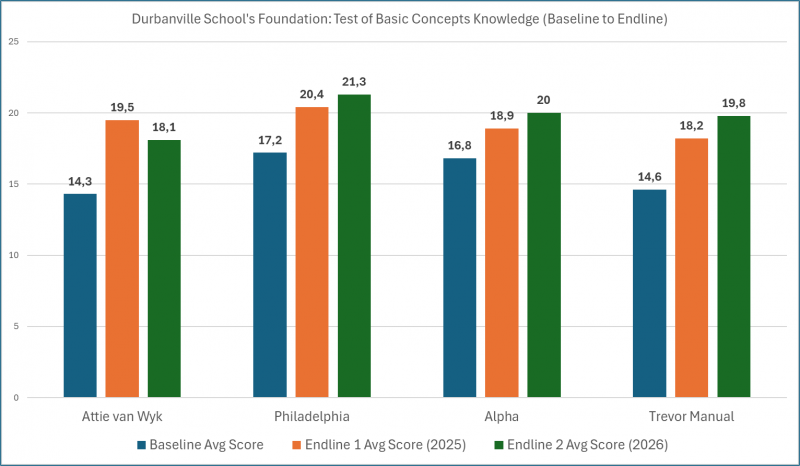
The data shows steady and meaningful progress across all four partner schools. The combined average score moved from 15.7 at baseline (below the preparedness benchmark of 18) to 19.25 in 2025, and 19.8 in 2026. Three of the four schools now have 90–100% of learners meeting preparedness expectations.
Beyond improved scores, these gains reflect strengthening general cognitive development. Learners are not simply memorising content; they are developing the ability to classify, compare, sequence, follow multi-step instructions and regulate their thinking. These cognitive tools form the foundation for literacy, numeracy and independent learning. The results suggest that when conceptual understanding is intentionally developed, children enter formal schooling better equipped to think, reason and engage with academic demands.